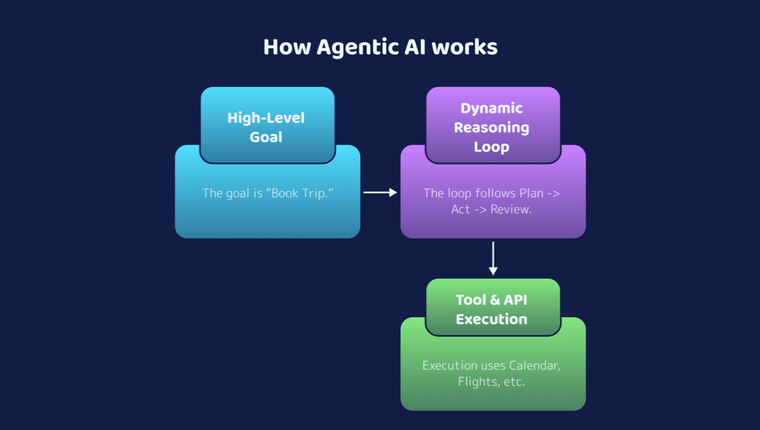
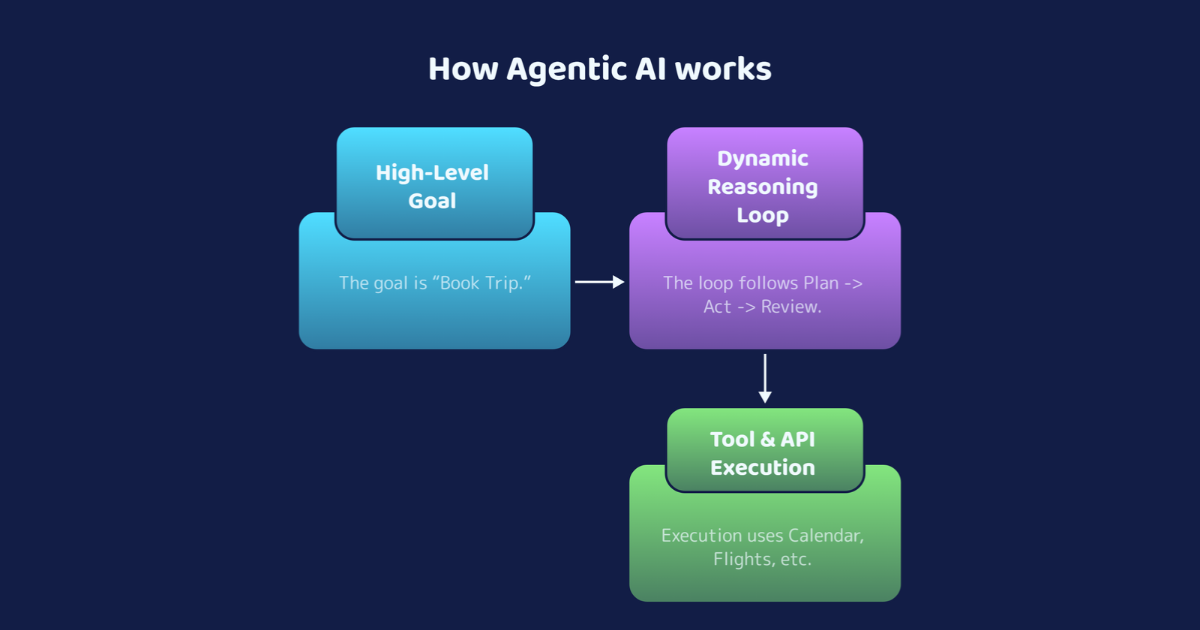
Agentic AI refers to artificial intelligence systems engineered with autonomy, goal-directed behavior, and decision-making capabilities. Unlike standard generative AI models that sit idle waiting for explicit human prompts, agentic AI operates proactively. It accepts high-level objectives, breaks them down into dynamic execution plans, interacts with software tools and APIs, and independently carries out complex tasks to achieve the target outcome.
What is Agentic AI?
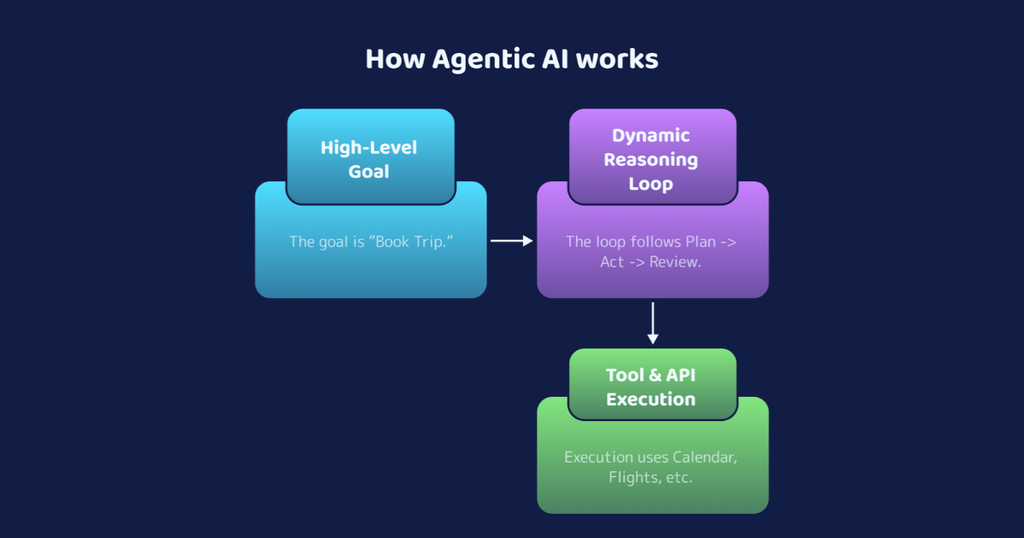
Agentic AI represents a paradigm shift from passive chat assistants to autonomous digital workers. When given an objective such as “Schedule a multi-city business trip within our travel budget and update calendar invites” an agentic system doesn’t just list recommendations. Instead, it queries flight databases, checks corporate travel policies, books tickets via REST APIs, manages calendars, and sends confirmation emails all with minimal human oversight.
Agentic AI vs Traditional AI
| Feature | Traditional / Generative AI | Agentic AI |
| Operational Mode | Reactive: Executes only upon explicit step-by-step user prompts. | Proactive & Autonomous: Operates on high-level goals with self-directed execution. |
| Workflow Topology | Single-turn responses or static linear pipelines. | Dynamic multi-step loops (Reasoning Action State Evaluation). |
| Tool Integration | Restricted to text/image generation within a single interface. | Native tool access via APIs, databases, web browsers, and sandboxed code execution. |
| Error Handling | Breaks or outputs inaccurate text when encountering bad data. | Self-Correcting: Detects failed tool calls, adjusts parameters, and retries alternate paths. |
| Architecture | Single isolated model execution. | Can operate as Multi-Agent Systems with specialized role handoffs. |
How AI Agents Work: 6 Key Characteristics
An AI agent continuously runs a cognitive execution loop composed of six functional building blocks:
1. Perception
The agent continuously monitors its operational environment, ingesting real-time data from user prompts, databases, system logs, sensor streams, or REST API payloads.
2. Reasoning & Planning
Using foundation models (such as GPT-4o, Claude 3.5, or Gemini 1.5 Pro) alongside paradigms like ReAct (Reason + Act), the agent decomposes abstract goals into structured action trajectories.
3. Goal-Setting & Sub-tasking
The agent converts fuzzy prompts into clear, measurable milestones, dynamically generating and re-prioritizing its internal to-do list as execution progresses.
4. Decision-Making
When encountering branching choices, the agent evaluates possible paths based on safety policy, cost budget, token efficiency, and performance constraints before invoking a tool.
5. Execution (Tool Invocation & MCP)
The agent takes digital action by calling external software tools, executing sandboxed code snippets, querying SQL databases, or utilizing open protocols like the Model Context Protocol (MCP) to interact with third-party software.
6. Learning & Memory
- Short-Term Memory: Maintains immediate session state, current execution scratchpads, and active token budgets.
- Long-Term Memory: Persists factual data (semantic memory) and chronological event logs (episodic memory) across sessions, allowing the agent to remember user preferences over time.
Specialized Roles & Multi-Agent Frameworks
In enterprise environments, a single AI agent often hits performance limits when handling long, complicated tasks. Organizations deploy Multi-Agent Orchestration Systems, where multiple specialized agents collaborate:
- LangGraph: A state-graph framework built for complex enterprise applications requiring explicit control, conditional branching, durable state checkpoints, and precise step-by-step execution.
- CrewAI: A role-based collaboration framework designed to set up specialized teams (e.g., Researcher Agent, Writer Agent, Reviewer Agent) with clear task handoffs.
- Microsoft Agent Framework / AutoGen: Enterprise-grade frameworks optimized for conversational agent collaboration, async messaging, and code-execution loops.
Practical Real-World Examples
- Customer Support & Service Operations: Resolves complex multi-step customer inquiries by querying CRM records, authenticating accounts, issuing refunds via payment APIs, and logging audit notes without escalating to human agents.
- IT & Cyber Defense Automation: Monitors network traffic anomalies, isolates infected infrastructure nodes, runs automated security patches in sandboxed environments, and generates incident post-mortems.
- Logistics & Supply Chain Management: Analyzes real-time traffic and weather patterns, calculates fuel consumption, automatically re-routes fleet deliveries, and updates inventory ERP databases.
- Human Resources & Onboarding: Manages complete employee onboarding workflows—collecting documents, setting up identity access management (IAM) accounts, ordering hardware, and scheduling orientation calls.
Key Technical Challenges & Best Practices
| Best Practice / Security Guardrail | Strategic Purpose |
| Human-in-the-Loop (HITL) Gates | Require explicit human confirmation before executing high-risk tool calls (e.g., financial transactions, database deletions, or external emails). |
| Strict Tool & Schema Scoping | Enforce typed schemas (e.g., Pydantic or OpenAPI) and apply the principle of least privilege to restrict agent system permissions. |
| Loop Prevention & Timeout Limits | Implement strict execution caps and retry limits to prevent agents from entering infinite API reasoning loops and running up cloud costs. |
| Observability & Audit Tracing | Utilize telemetry platforms (e.g., LangSmith, Arize, OpenTelemetry) to track token overhead, latency, tool invocation logs, and decision trees. |
Agentic AI FAQ
Why does agentic AI matter for enterprises?
Agentic AI moves technology beyond simple text drafting into full task delegation. It frees human teams from administrative overhead and automates end-to-end multi-step business workflows at scale.
Are there major risks or challenges with agentic AI?
Yes. Key risks include non-deterministic agent choices, prompt injection attacks that alter agent goals, security vulnerabilities from tool access, uncontrolled API costs, and context saturation during long workflows.
Is ChatGPT an AI agent?
Standard ChatGPT acts primarily as a conversational LLM. However, when equipped with web browsing, Code Interpreter, custom GPT actions, or automated plugins, it acts as a basic AI agent.
How do agents communicate with each other?
Multi-agent systems communicate using structured message-passing protocols, shared memory graphs, or standardized API standards like Anthropic’s Model Context Protocol (MCP) and Google’s Agent2Agent (A2A) framework.