

They pay thousands of dollars a month for bloated, out-of-the-box SaaS platforms that barely move the needle.
Here is the truth: The most powerful AI tools for business right now aren’t heavily marketed enterprise applications. They are sitting right in plain sight on GitHub.
Using open-source AI software gives your business three massive advantages: total control, strict data privacy, and zero recurring API licensing fees. Whether your goal is workflow automation, building internal knowledge bases using RAG (Retrieval-Augmented Generation), or deploying autonomous AI agents, the developer community has already built it.
If you want to build a serious enterprise AI stack this year, here is a curated list of the top 10 AI tools on GitHub.
Table of Contents
- n8n (Workflow Automation)
- Dify (LLM App Development)
- Ollama (Local AI Inference)
- AnythingLLM (Knowledge Workspace)
- CrewAI (Multi-Agent Automation)
- Flowise (Visual AI Workflows)
- Open WebUI (ChatGPT Alternative)
- LangChain (AI Framework)
- LlamaIndex (Data Framework for LLMs)
- Supabase (Vector Database & Auth)
1. n8n
GitHub Repository: n8n-io/n8n
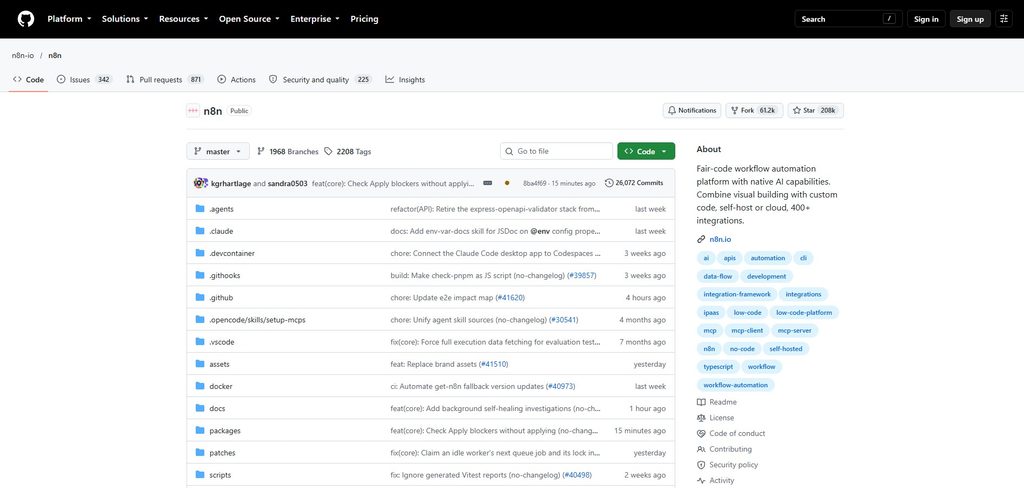
If you want to integrate AI into your daily operations, n8n is the undisputed king of workflow automation. Think of it as Zapier on steroids, but open-source and self-hostable.
Why it’s entity-optimized for business:
- Advanced AI Nodes: It integrates directly with major Large Language Models (LLMs), meaning you can build workflows that perform natural language processing, sentiment analysis, and logic routing.
- Data Privacy Compliance: Because you self-host it, your sensitive CRM or financial data never has to ping a third-party server.
2. Dify
GitHub Repository: langgenius/dify
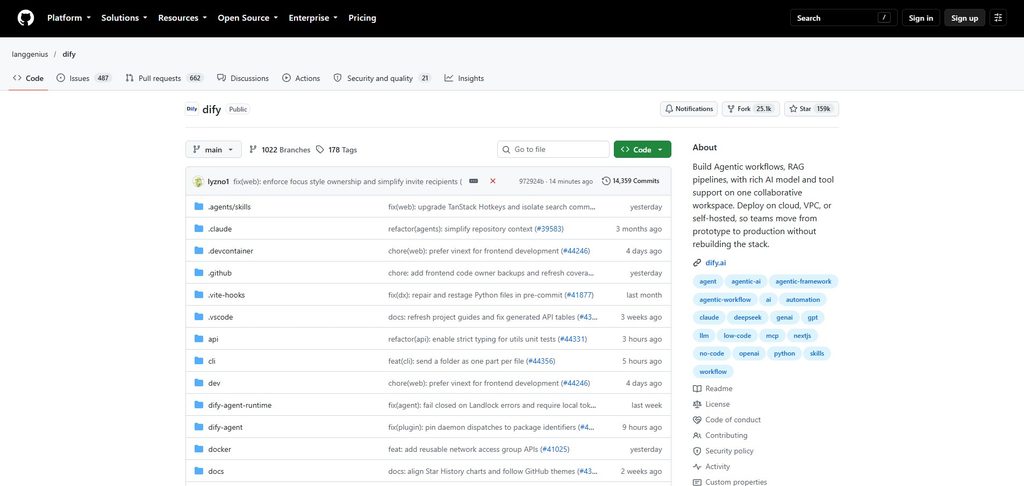
Building a generative AI application used to require a team of specialized machine learning engineers. Not anymore. Dify is an incredible open-source LLM app development platform specifically designed to help businesses build production-ready AI workflows.
Why it’s great for business:
- Enterprise RAG Out-of-the-box: Upload your company’s PDFs and proprietary datasets. Dify handles the vector embedding, allowing you to build an AI assistant that answers questions based only on your secure data.
- Visual Orchestration: No Python coding required to orchestrate complex prompt engineering or model routing.
3. Ollama
GitHub Repository: ollama/ollama
Sending proprietary source code or client data to external OpenAI API endpoints is a massive cybersecurity risk. The solution? Local inference. Ollama is the “Docker for local AI,” allowing you to run open-weight machine learning models (like Meta’s Llama 3) directly on your own hardware.

Why it’s great for business:
- Air-Gapped Security: Your data never touches the internet.
- Cost Efficiency: Once you provision the GPU hardware, generating text and processing data is 100% free.
4. AnythingLLM
GitHub Repository: Mintplex-Labs/anything-llm
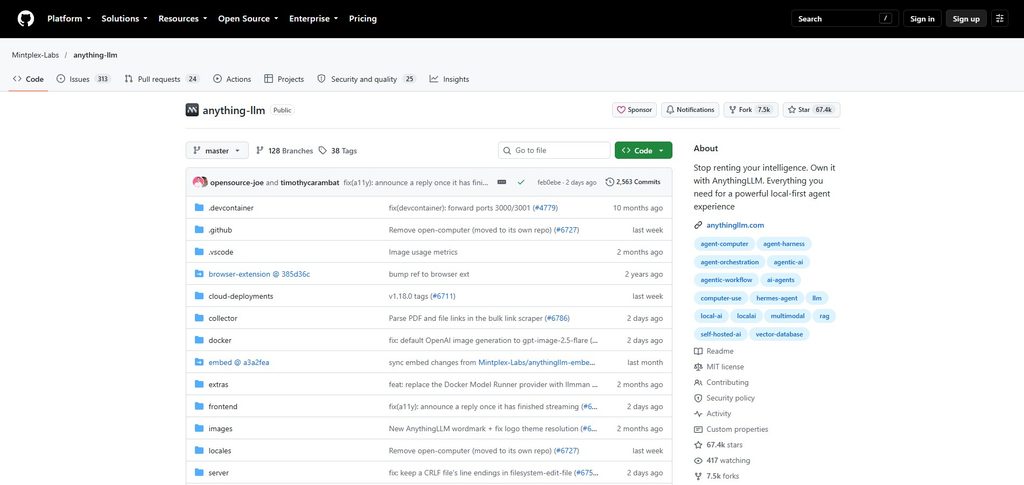
If your goal is to turn your company’s messy Google Drive into a hyper-intelligent chatbot, you need AnythingLLM. It is a full-stack enterprise application that turns any document or resource into context for an LLM.
Why it’s great for business:
- Multi-User Management: Built-in enterprise features like custom user roles, granular permissions, and isolated workspaces.
- Model Agnostic: Hot-swap between cloud models (Anthropic Claude) and local models (via Ollama) depending on document sensitivity.
5. CrewAI
GitHub Repository: crewAIInc/crewAI
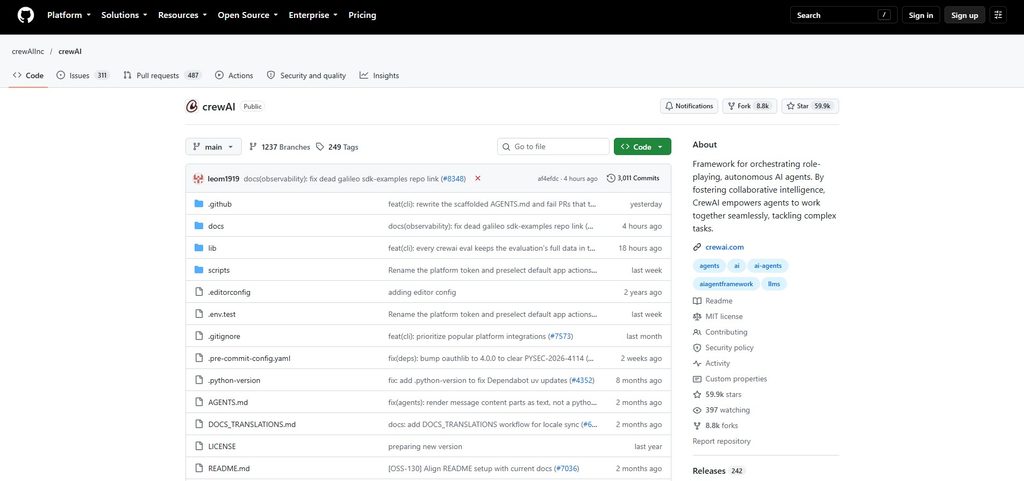
We are moving past simple chatbots and entering the era of AI Agents autonomous systems that can plan, use tools, and execute multi-step goals. CrewAI is a cutting-edge framework for orchestrating role-playing, autonomous AI agents.
Why it’s great for business:
- Digital Workforce: Define specific roles (e.g., “Senior Market Researcher”) and have multiple AI agents collaborate to complete complex tasks.
- Action-Oriented: Agents can be equipped with custom tools to scrape the web, read SQL databases, and execute code.
6. Flowise
GitHub Repository: FlowiseAI/Flowise
Flowise is an open-source UI visual tool to build customized LLM flows using LangchainJS, written in Node Typescript/Javascript. It brings a drag-and-drop interface to AI development.
Why it’s great for business:
- Rapid Prototyping: Build LLM apps, custom chatbots, and RAG pipelines in minutes instead of weeks.
- Low-Code Barrier: Allows product managers and business analysts to create complex AI logic visually without relying entirely on backend developers.
7. Open WebUI
GitHub Repository: open-webui/open-webui
If you are running models locally using Ollama, your non-technical employees still need a user-friendly way to interact with them. Open WebUI provides a sleek, feature-rich interface that looks and functions almost exactly like ChatGPT.
Why it’s great for business:
- Familiar UX: Zero training required for employees who already know how to use ChatGPT.
- Full Data Sovereignty: When paired with local LLMs, you get an enterprise-grade chat interface where you own 100% of the data and interaction logs.
8. LangChain
GitHub Repository: langchain-ai/langchain
LangChain is the foundational open-source framework for developing applications powered by language models. It is the underlying engine that connects LLMs to your company’s specific context and tools.
Why it’s great for business:
- The Industry Standard: It boasts the largest community of AI developers, meaning finding talent to work on LangChain-based enterprise apps is easier.
- Extensibility: Features thousands of pre-built integrations for enterprise databases, APIs, and SaaS tools.
9. LlamaIndex
GitHub Repository: run-llama/llama_index
While LangChain is a general-purpose framework, LlamaIndex is purpose-built for data ingestion and indexing. It is the premier data framework for connecting custom data sources to large language models.
Why it’s great for business:
- Advanced Data Connectors: Ingest data natively from Salesforce, Notion, Google Drive, and SQL databases.
- Optimized for RAG: Provides advanced indexing strategies to ensure your AI apps retrieve the most accurate and relevant business data, eliminating hallucinations.
10. Supabase
GitHub Repository: supabase/supabase
Every AI application needs a database to store user authentication, chat logs, and vector embeddings. Supabase is the premier open-source Firebase alternative, and it has heavily optimized its PostgreSQL database for AI workloads.
Why it’s great for business:
- pgvector Support: Natively supports storing and querying vector embeddings directly in your Postgres database, removing the need for a separate, expensive vector database.
- Enterprise Scalability: Offers production-ready authentication, row-level security, and automatic APIs out of the box.
To help you decide which tool fits your specific tech stack, I’ve put together an interactive matrix of these top open-source AI projects. You can filter by category and business utility here: