

Staring at a blinking cursor on a blank Word document?
I’ve been there.
Writing a thesis, dissertation, or research paper is flat-out exhausting. You have to read hundreds of papers, synthesize complex data, and somehow format all your citations correctly.
It takes forever.
But recently, the game has changed completely.
Artificial Intelligence is everywhere. But here is the problem:
Most generic AI tools (like the standard version of ChatGPT) are terrible for academic writing. They hallucinate facts. They make up fake citations. And they trigger academic plagiarism detectors like crazy.
So, what is the actual best AI tool for academic writing?
The short answer: There isn’t just one. You need a specialized stack.
Let’s dive right into the top 10 AI tools you should be using right now to research, write, and edit your academic papers.
1. Jenni.ai (Best for Drafting and In-Text Citations)
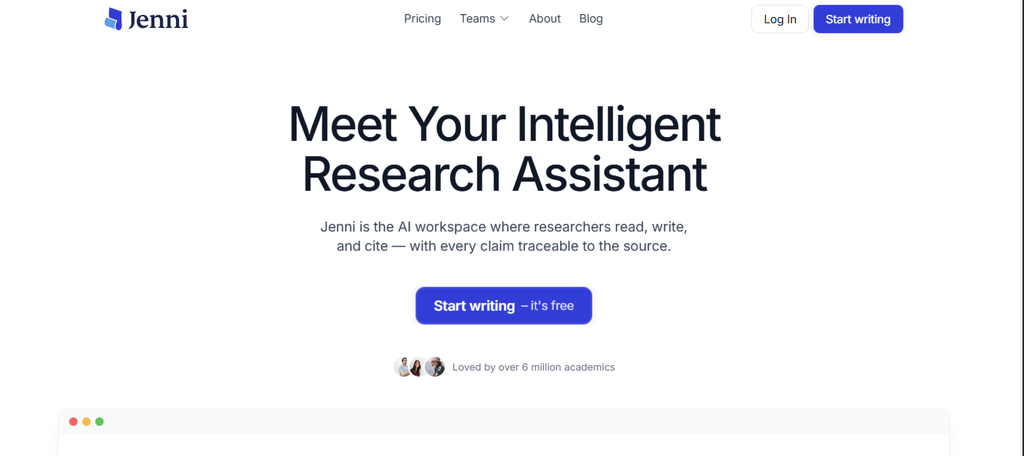
If I had to pick just one tool to call the absolute best, it’s the specialized academic writing assistant Jenni.ai.
Why? Because it was built from the ground up for students and researchers.
When you use generic AI, you run into the dreaded “hallucination” problem (which major scientific journals like Nature have actively warned researchers against).
Jenni.ai doesn’t invent fake science.
Why it works:
- Built-in Literature Library: Upload your own PDFs. Jenni pulls facts directly from your research, meaning every sentence is grounded in reality.
- Real Citations: Every claim it generates is backed by a verified citation, strictly adhering to official APA style formatting guidelines (or MLA, Harvard, IEEE). It even builds your bibliography automatically.
- AI Autocomplete: It acts as an assistant, unblocking writer’s block by suggesting the next sentence. You remain in the driver’s seat, ensuring your voice shines through.
2. Consensus (Best for Scientific Search)
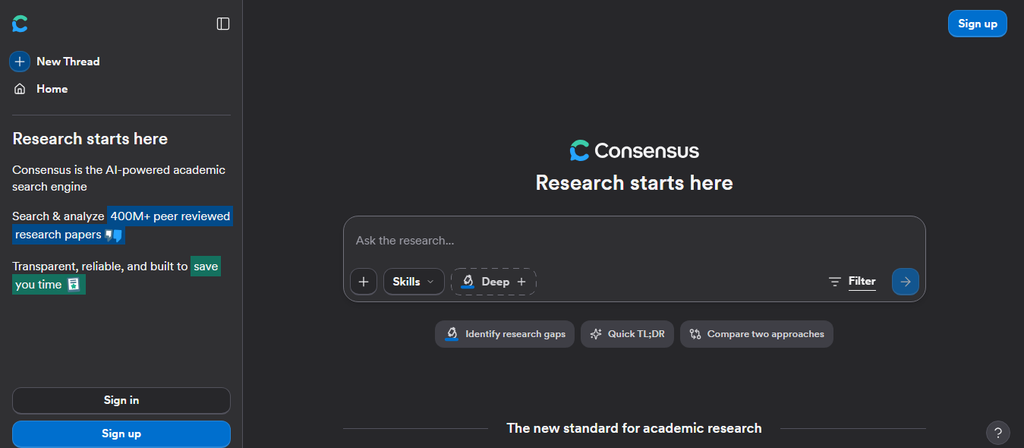
Writing a literature review is usually the hardest part of any paper. Searching through Google Scholar can feel like finding a needle in a haystack.
Enter the AI-powered scientific search engine Consensus.
Think of Consensus as Google Scholar on steroids. It is an AI search engine designed exclusively to search over 200 million peer-reviewed scientific papers.
Why it works:
- Direct Answers from Data: Ask “Does creatine improve cognitive function?” and it scans millions of papers to give you a synthesized summary of the scientific consensus, complete with an overarching “Yes/No/Possibly” meter.
- High-Trust Data Sources: It only pulls from verified academic databases, leveraging the massive Semantic Scholar academic corpus. You never get stuck citing a random blog post or unverified opinion.
3. Elicit (Best for Literature Reviews and Data Extraction)
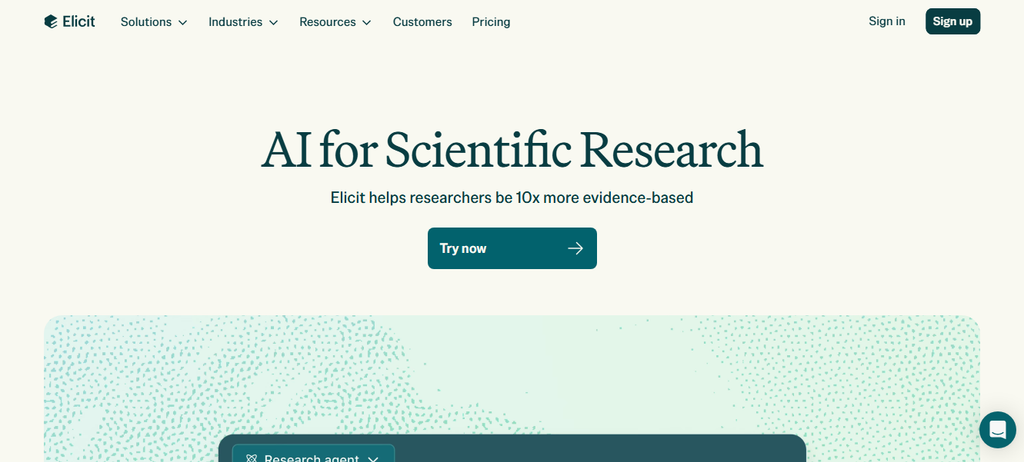
While Consensus is great for quick answers, the heavy-duty literature review tool Elicit is your best bet for deep-dive research and systematic reviews.
Why it works:
- Research Matrices: Elicit can extract specific, granular data points (like methodology, participant demographics, sample size, and P-values) from dozens of PDFs simultaneously.
- Instant Tables: It takes all that dense academic data and organizes it into a neat Excel-style table for you. You can literally export this into a CSV to streamline your systematic literature review process.
Pro Tip: Use Elicit to find and filter the right papers, export them, and then upload those PDFs into Jenni.ai to start writing.
4. Scite.ai (Best for Citation Checking)
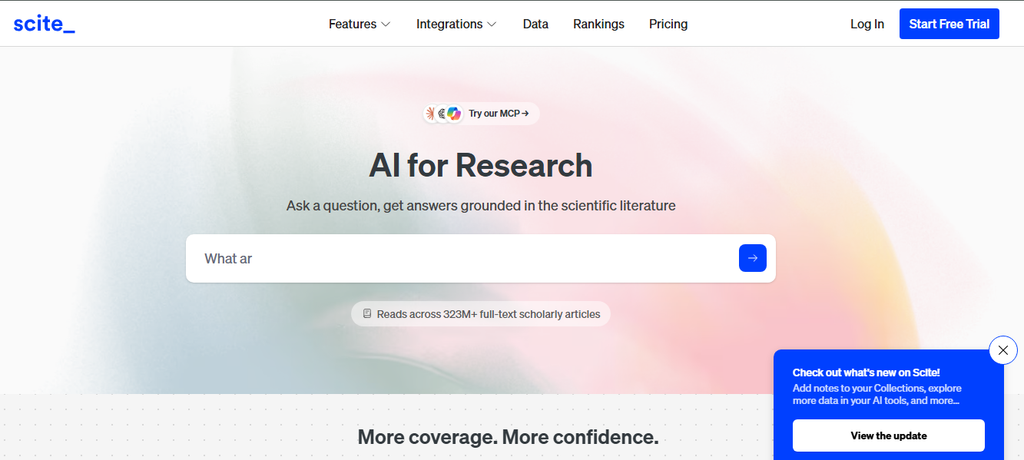
Have you ever cited a paper, only to find out later that the study was completely debunked?
The smart citation analysis tool Scite.ai fixes this massive headache. It uses AI to show you exactly how a paper has been cited by others.
Why it works:
- Context Matters: It features a unique visual badge system. It tells you if subsequent research actively supported, contrasted, or just casually mentioned the paper you want to cite.
- Bulletproof Your Claims: It ensures you are building your argument on rock-solid, widely accepted research rather than accidentally referencing officially retracted scientific papers.
5. ChatPDF (Best for Skimming Long Papers)
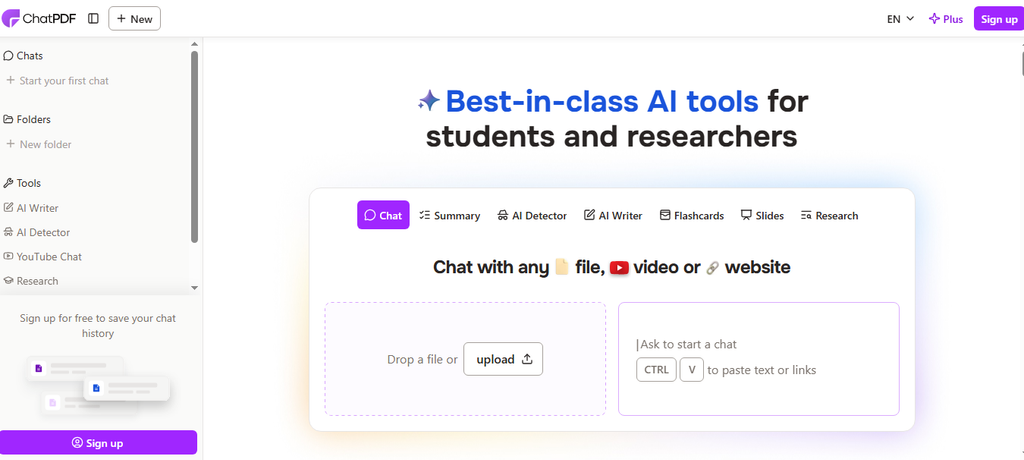
Sometimes you find a 40-page PDF and just need to know if it’s relevant to your thesis.
The interactive document reading assistant ChatPDF lets you literally “talk” to your document like you would a colleague.
Why it works:
- Instant Summaries: Upload the PDF and ask, “What were the main limitations of this study?” or “Summarize the methodology in 3 bullet points.”
- Pinpoint Accuracy: It jumps straight to the relevant paragraph and provides clickable page references, saving you hours of mindless skimming.
6. QuillBot (Best for Academic Paraphrasing)
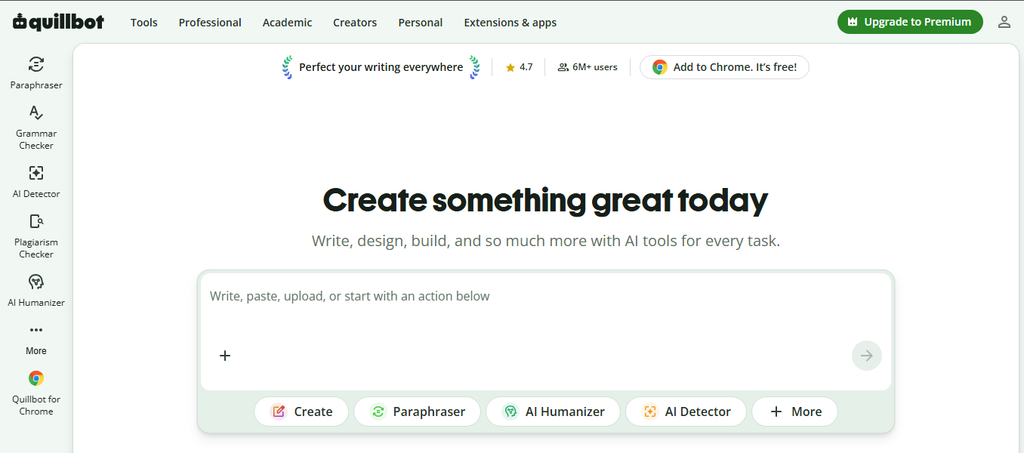
Okay, so you have your research and a rough draft. Now you need to make it sound professional.
While general grammar checkers are okay, the advanced academic paraphrasing tool QuillBot is the undisputed king of refining your sentence structure.
Why it works:
- Academic Mode: QuillBot’s “Academic” or “Formal” sliders will instantly elevate your vocabulary to match journal standards.
- Overcoming Clunky Sentences: It gives you 5 different variations for any sentence that just feels wrong.
- Maintain Academic Integrity: It helps you properly paraphrase complex ideas. Just remember that paraphrasing still requires citation to avoid accidental academic plagiarism.
7. Paperpal (Best for Academic Proofreading)
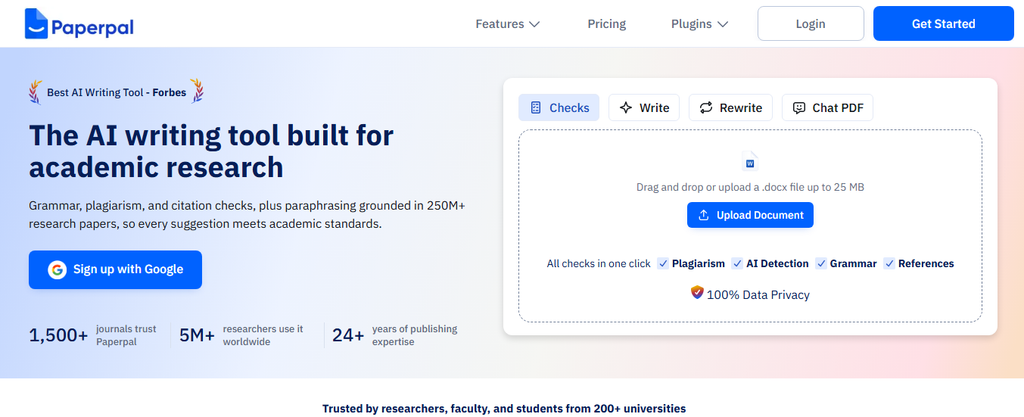
Grammarly is built for emails, blogs, and general writing. The manuscript proofreading software Paperpal is built specifically for academic manuscripts.
Why it works:
- Trained on Journals: The AI has been trained on millions of published academic articles from top publishers.
- Journal Readiness: It checks for structural issues, academic tone, consistency in terminology, and specific formatting requirements before you submit to a journal. It can even predict your chances of passing a desk rejection.
8. Scholarcy (Best for Creating Flashcards)
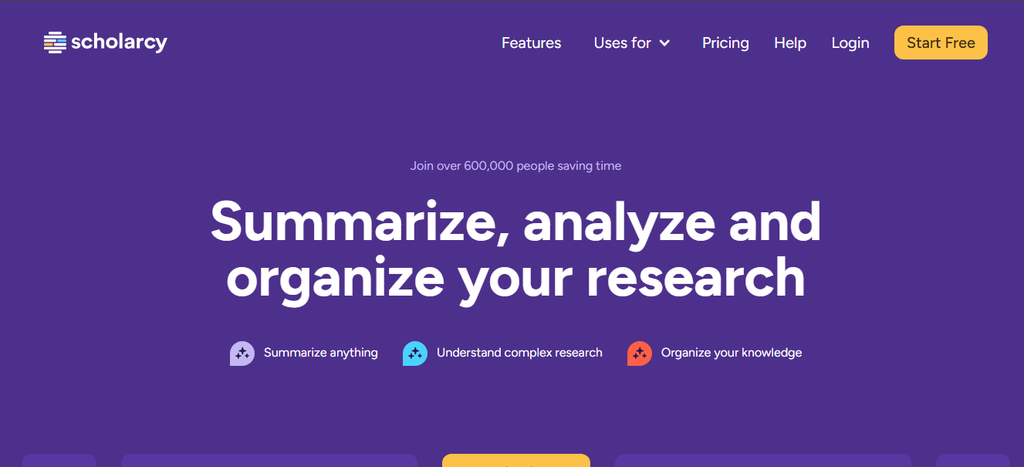
If you get overwhelmed by the sheer volume of reading you have to do, the AI article summarizer Scholarcy is an absolute lifesaver.
Why it works:
- Interactive Flashcards: It breaks down massive papers into bite-sized, interactive flashcards that you can save to your own personal library.
- Extracts the Good Stuff: Its “Robo-Highlighter” automatically identifies and highlights the key facts, figures, and references so you can review a complex paper in 2 minutes flat.
9. Grammarly (Best for Final Polish)
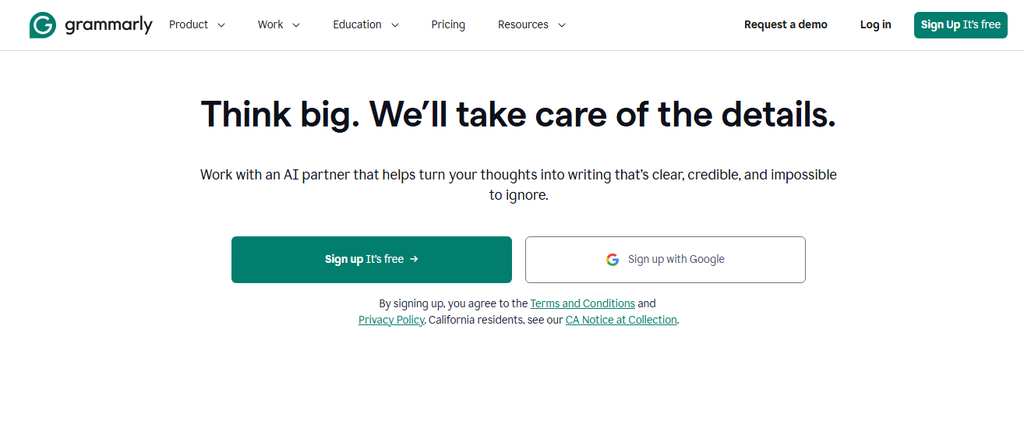
You already know about it, but the comprehensive grammar checking tool Grammarly still deserves a spot on this list.
Why it works:
- The Last Line of Defense: Before you hit submit, run your paper through Grammarly Premium to catch lingering typos, passive voice errors, and comma splices. Its built-in plagiarism checker is also incredibly helpful as a final sanity check.
10. Perplexity AI (Best for Exploratory Research)
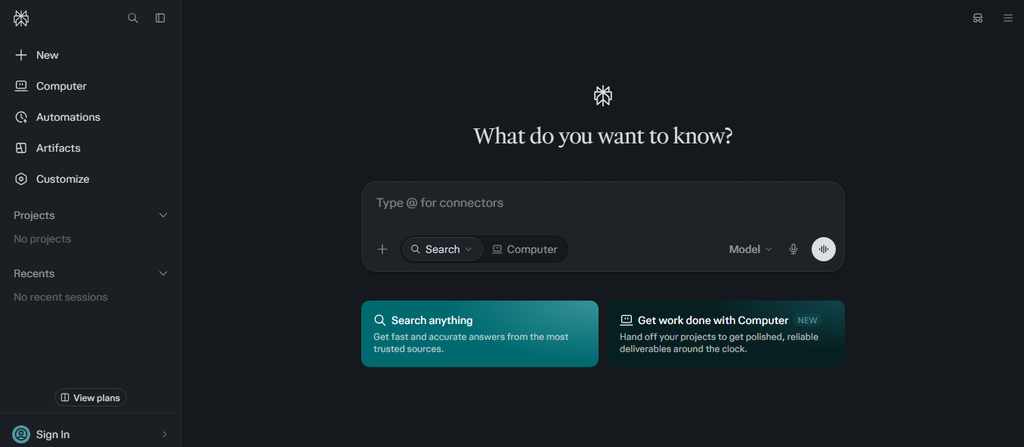
ChatGPT is notoriously bad at citing its sources. The exploratory AI search engine Perplexity is incredibly good at it.
Why it works:
- A Better AI Chatbot: If you are in the early brainstorming phase, Perplexity acts like a super-smart librarian. Every answer it gives includes clickable footnote links to the sources it used to generate the text.
- Pro Features: If you upgrade, it allows you to use premium models like Claude 3.5 or GPT-4o, giving you access to top-tier reasoning alongside verifiable internet searches.
My Recommended 3-Step AI Workflow
If you want to write a high-quality academic paper faster, do not just pick one tool. Chain them together.
Here is the exact workflow I recommend:
- The Discovery Phase: Start with Consensus to ask your main research question and gauge the scientific landscape. Then, use Elicit to pull up 15-20 relevant papers and extract their core data into a spreadsheet.
- The Synthesis Phase: Drop those dense PDFs into ChatPDF or Scholarcy to quickly summarize the methodology and limitations without reading 400 pages manually.
- The Writing Phase: Upload your chosen, high-quality sources into Jenni.ai. Begin drafting your paper, letting Jenni handle the in-text citations. Finally, run the finished draft through Paperpal to ensure the tone is perfectly aligned with academic journal standards.
The Elephant in the Room: AI Detectors
We need to talk about Turnitin and AI detectors.
Universities are cracking down. If you just copy-paste a prompt into an AI and submit it, you will get caught. (And rightly so).
The goal of using AI in academia is not to have the machine do the work for you. The goal is to use AI as a research assistant.
You must be the one providing the critical thinking, the arguments, and the overarching structure. Follow guidelines provided by institutions like the Yale Poorvu Center for Teaching and Learning regarding acceptable AI use.
Frequently Asked Questions (FAQs)
What is the best free AI tool for academic writing?
While most top-tier tools require a subscription, Consensus and Perplexity AI offer incredibly robust free versions for research. QuillBot also has a functional free tier for basic paraphrasing.
Can Turnitin detect Jenni.ai or ChatGPT?
Yes. Turnitin and other academic software have updated their algorithms to detect AI-generated syntax. This is why you should never use AI to write your paper from scratch. Use tools like Jenni.ai strictly as an assistant to outline and help with citations, but write the core arguments in your own voice.
Is using AI for academic writing considered cheating?
It depends on how you use it. Having AI write your entire essay is a violation of academic integrity. However, using AI to check your grammar (Paperpal), format your citations (Jenni.ai), or summarize long PDFs (ChatPDF) is widely considered acceptable and is encouraged by many modern professors. Always check your university’s specific AI policy.
Over To You
There you have it: the ultimate top 10 AI stack for academic writing.
Now I’d like to hear from you:
Which of these tools are you going to try first?
Are you going to use Elicit to speed up your literature review? Or maybe Scite.ai to double-check your citations?
Let me know by leaving a quick comment below right now.